










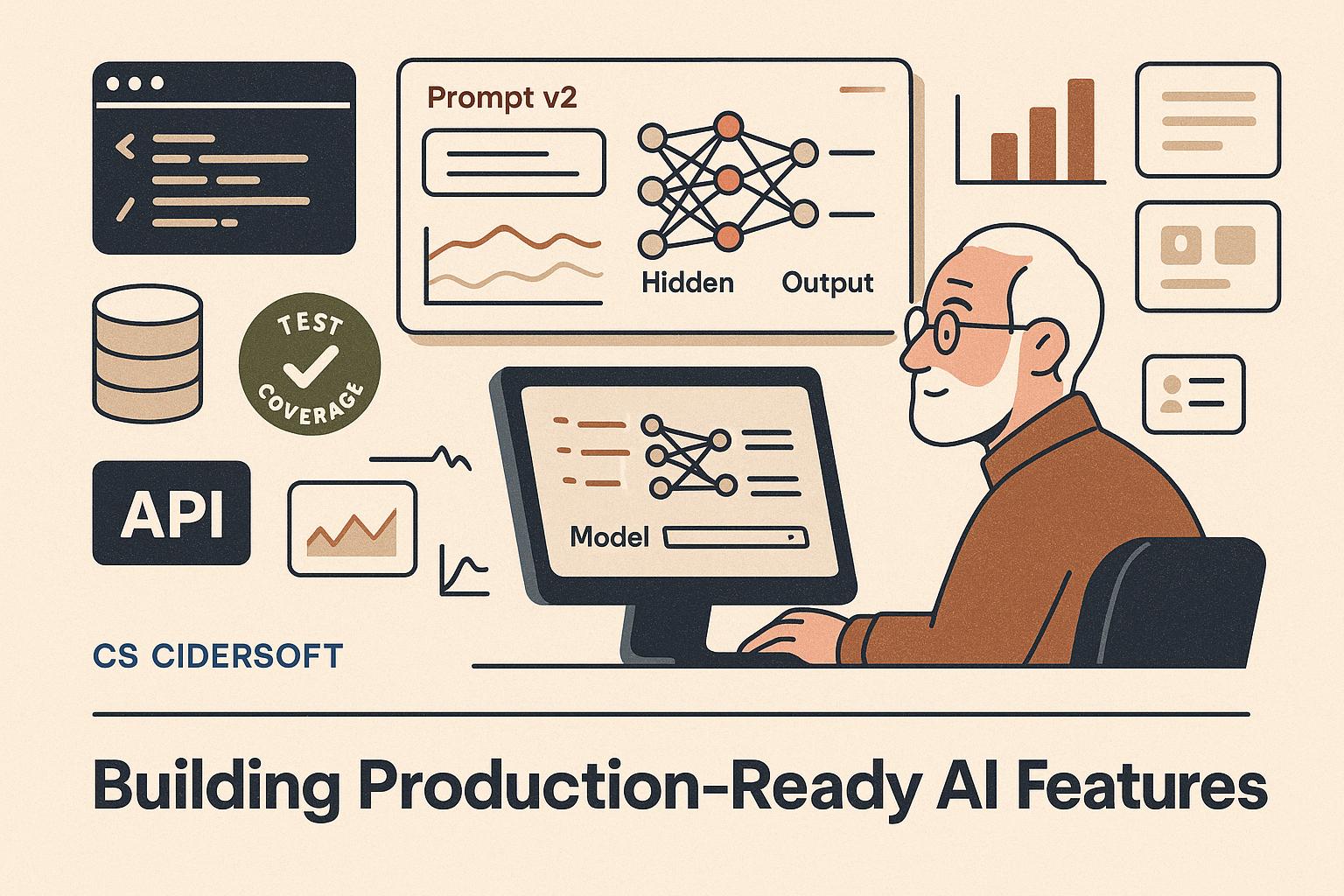
Every engineering team is prototyping with AI right now. The demos are impressive. The production deployments are not. The gap between a compelling proof-of-concept and a reliable, maintainable AI feature is where most teams are quietly struggling , and where most of the interesting engineering problems actually live.
This is what Cidersoft's senior engineers have learned shipping AI features in production environments over the past two years.
The Demo Trap
AI prototypes are dangerously easy to build. Wrap a GPT-4 API call in a few lines of Python, hook it to a frontend, and you have something that looks production-ready in an afternoon. The problem surfaces at scale: inconsistent outputs, no error handling, no fallbacks, no observability, and prompt logic scattered across codebase with no versioning.
Production AI features require the same engineering rigor as any other system-critical component , plus a new category of problems that most teams haven't encountered before.
1. Treat Prompts as Code
The single highest-leverage practice for production AI is prompt version control. Your prompts are logic. They should live in your repo, have commit history, be tested against a fixed evaluation set before deployment, and roll back cleanly if something breaks.
We've seen teams lose weeks of quality work because a prompt "improvement" degraded output on edge cases that weren't caught in manual testing. A simple eval harness , even 20 representative test cases with expected output patterns , would have caught it in CI.
2. Design for Model Failure
Models hallucinate. Latency spikes. APIs go down. Any production AI feature that assumes the model will always return valid, structured output will fail in production. Design for failure modes explicitly:
- Validate and sanitize all model output before it touches your data layer
- Build fallbacks for every AI-powered path , what happens when the model returns garbage?
- Set aggressive timeouts and cache aggressively where output is deterministic enough
- Log every model call with input, output, latency, and model version
3. Structured Output Is Non-Negotiable at Scale
Free-form text output from a model is fine for chat interfaces. For any feature where AI output feeds another system , a database, a UI component, a downstream API , you need structured output with schema validation. Use JSON mode or function calling APIs, validate against a schema on every response, and never parse free-form text into structured data unless you have extensive test coverage on the parser.
4. Observability for AI Is Different
Standard application observability (error rates, latency, uptime) is necessary but not sufficient for AI features. You also need:
- Output quality metrics , track the distribution of outputs over time; quality drift is a real phenomenon
- User correction signals , if users are editing AI-generated content, that's signal; capture it
- Cost per feature , model API costs compound quickly; instrument at the feature level, not just the account level
- Prompt performance dashboards , which prompts are producing high-quality outputs? Which are degrading?
5. Model Selection Is an Engineering Decision
Teams default to the most powerful available model because it produces the best demo output. In production, model selection should be driven by the accuracy threshold the feature actually requires, combined with latency and cost requirements.
A content tagging feature that needs to be right 85% of the time can run on a smaller, faster, cheaper model. A compliance-critical document analysis feature that needs to be right 99.5% of the time should run on the best available model with human review in the loop. Using GPT-4 for everything is expensive and slow; using GPT-3.5 for everything produces inconsistent quality. Segment by requirement.
Putting It Together
The teams shipping reliable AI features in 2025 aren't the ones with the most AI expertise , they're the ones applying existing engineering discipline to a new class of component. Treat prompts as code, design for failure, instrument everything, and match model capability to actual requirements.
If your team is at the prototype-to-production transition and running into the gaps described above, Cidersoft's engineering team has hands-on experience building this infrastructure. Let's talk about what you're building.